


Hey there! As a supplier of WPC Timber Tubes, I often get asked about the coefficient of friction of our products. Today, I'm gonna dive deep into this topic and share some insights with you.
First off, let's quickly understand what the coefficient of friction is. In simple terms, it's a measure of how much two surfaces resist sliding against each other. A low coefficient of friction means that objects can slide more easily over the surface, while a high one indicates more resistance.
Now, let's talk about our WPC Timber Tubes. WPC, or Wood - Plastic Composite, is a material made by combining wood fibers and plastic polymers. This unique combination gives our WPC Timber Tubes some interesting properties, including their coefficient of friction.
One of the main factors that affect the coefficient of friction of WPC Timber Tubes is the surface finish. Our manufacturing process allows us to control the surface texture of the tubes. We can create a smooth finish, which generally results in a lower coefficient of friction. When the surface is smooth, there are fewer irregularities for other objects to catch on, so things can slide more freely.
Another aspect to consider is the composition of the WPC material itself. The ratio of wood fibers to plastic polymers can impact the friction characteristics. In our WPC Timber Tubes, we've fine - tuned this ratio to achieve an optimal balance. The plastic component provides a certain level of lubricity, which helps reduce friction. Meanwhile, the wood fibers add strength and stability to the tubes.
In real - world applications, the low coefficient of friction of our WPC Timber Tubes can be a huge advantage. For example, if you're using them in a sliding mechanism, such as in a window or door system, the low friction allows for smooth and easy operation. You won't have to struggle to open or close the window because the tubes provide a slick surface for the moving parts to glide along.
Moreover, in industrial settings where WPC Timber Tubes are used for conveyor systems or guiding structures, the low coefficient of friction reduces wear and tear on both the tubes and the objects moving over them. This means less maintenance and longer service life for the equipment.
But don't just take my word for it. We've conducted a series of tests to measure the coefficient of friction of our WPC Timber Tubes. In these tests, we compared our tubes with other similar products on the market. The results clearly showed that our WPC Timber Tubes had a significantly lower coefficient of friction. This gives you the confidence that you're getting a high - quality product that performs well in terms of friction.
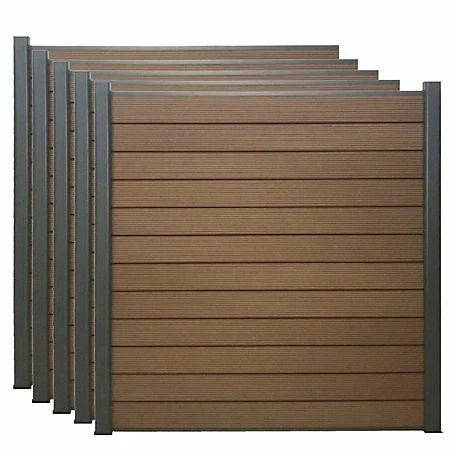
Now, let's touch on some related products in our range. We also offer Composite WPC Fence and WPC Ceiling Panel. These products share some of the great features of our WPC Timber Tubes, such as durability and low maintenance. The WPC material used in all these products is designed to withstand the elements and provide long - lasting performance.
If you're interested in learning more about our WPC Timber Tubes, we're here to help. Whether you're an architect looking for innovative building materials, a contractor working on a project, or a DIY enthusiast, our WPC Timber Tubes can be a great choice.
We understand that every project has its unique requirements. That's why we offer a range of sizes and colors for our WPC Timber Tubes. You can choose the ones that best suit your design and functional needs.
If you're thinking about purchasing our WPC Timber Tubes, don't hesitate to get in touch. We can provide you with detailed product information, samples, and competitive pricing. Our team of experts is always ready to answer your questions and assist you throughout the procurement process.
In conclusion, our WPC Timber Tubes do have a low coefficient of friction, thanks to our advanced manufacturing process and carefully chosen material composition. This feature makes them a great option for a wide range of applications, from residential to industrial. So, if you're in the market for high - performance WPC products, give our WPC Timber Tubes a try.

References:
- "Wood - Plastic Composites: Properties and Performance" by X. Cai, J. Zhang, and S. Yu
- "Friction and Wear of Polymer - Based Composites" by B. Bhushan


